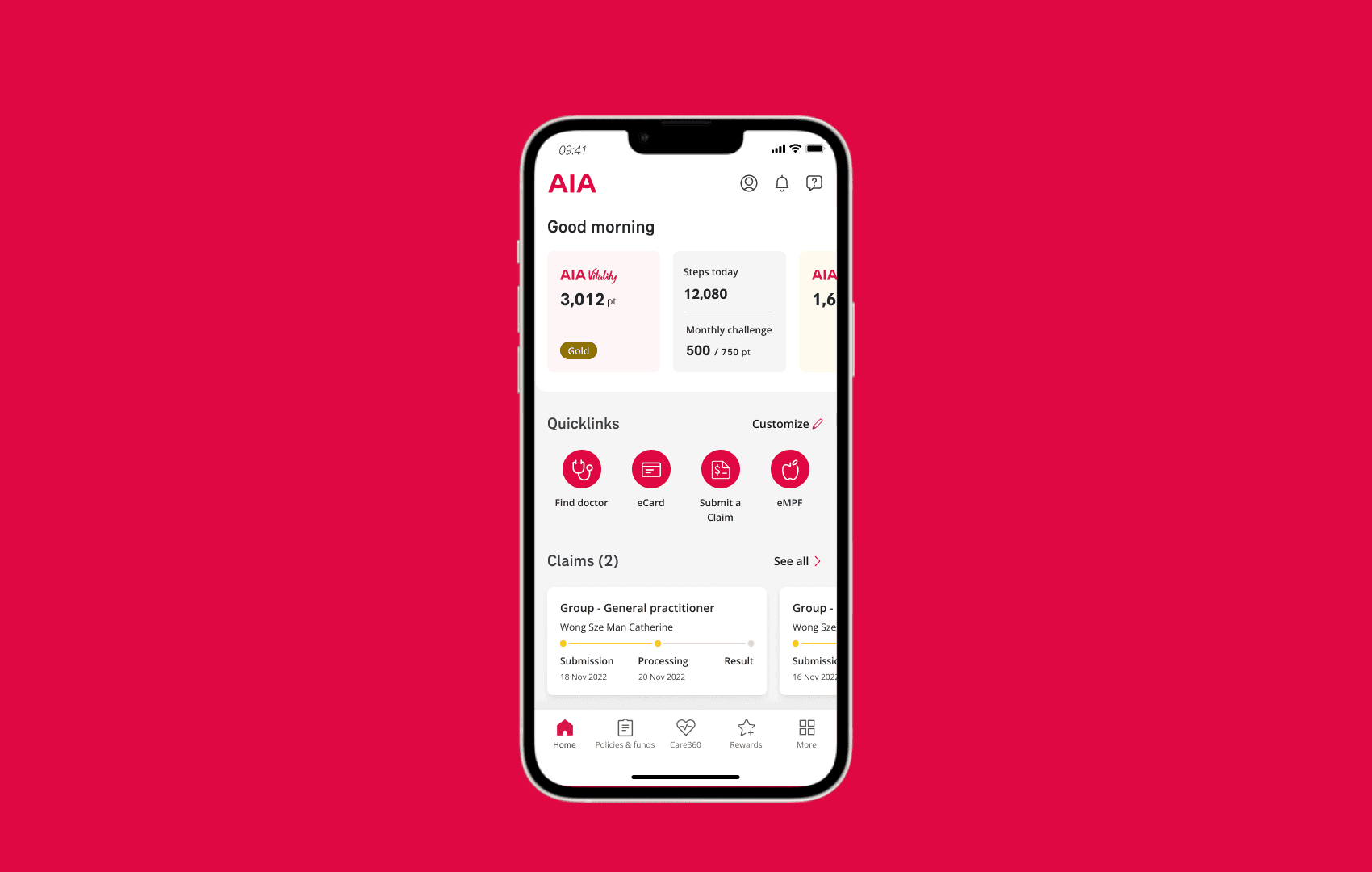
AIA+ Web and App: From Episodic App to Daily Wellness Platform
Transformed AIA Connect from an episodic servicing app into a daily wellness and insurance platform used across multiple Asian markets.
Senior UI/UX Designer
Multi-release
2023
Insurance
Impact at a glance
80+ across journeys
SUS score
#1 preferred
Claims journey
Red Dot Design Award winner
Award
In parallel, this redesign served as a reference foundation for a new component-based design system. Patterns created for real product use became the baseline references for scalable implementation across future AIA digital products.
Problem
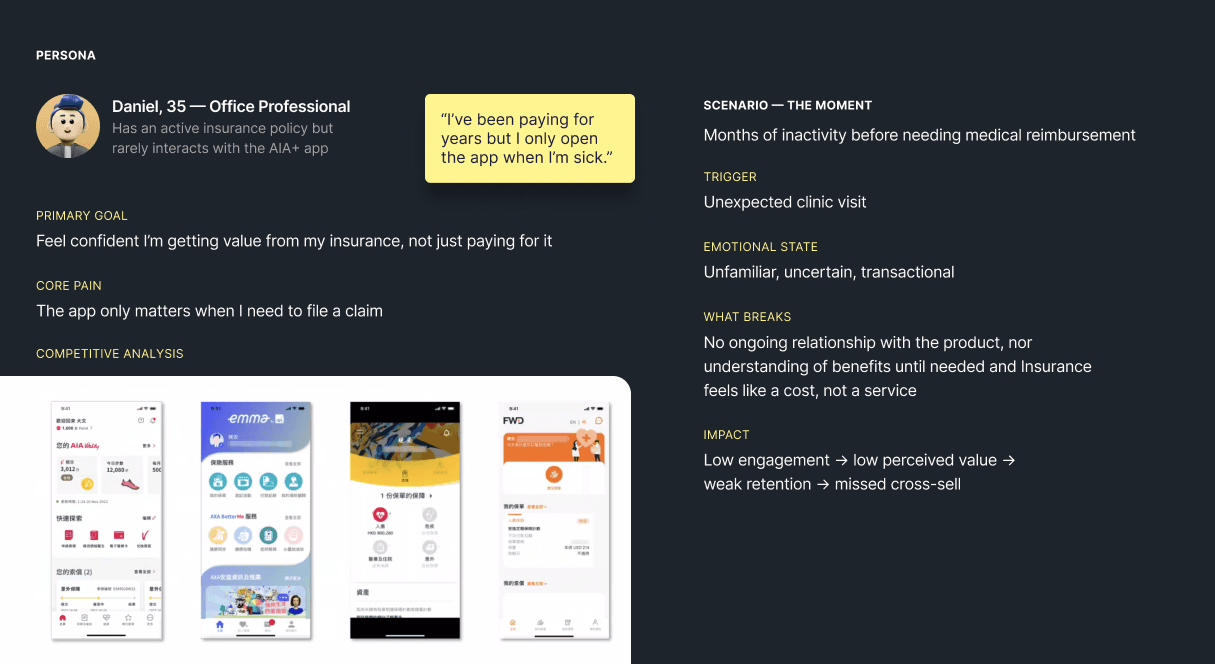
AIA Connect struggled not only because of navigation or legacy UI patterns, but because insurance products are inherently episodic.
- Most customers only open an insurance app when something goes wrong, which makes long-term engagement naturally low. As a result, the app functioned as an emergency tool rather than a relationship channel; healthy users had little reason to return, leading to low perceived value and limited product exploration.
- The challenge was not simply to improve task completion, but to make the product relevant before protection is needed.
Research to Strategy
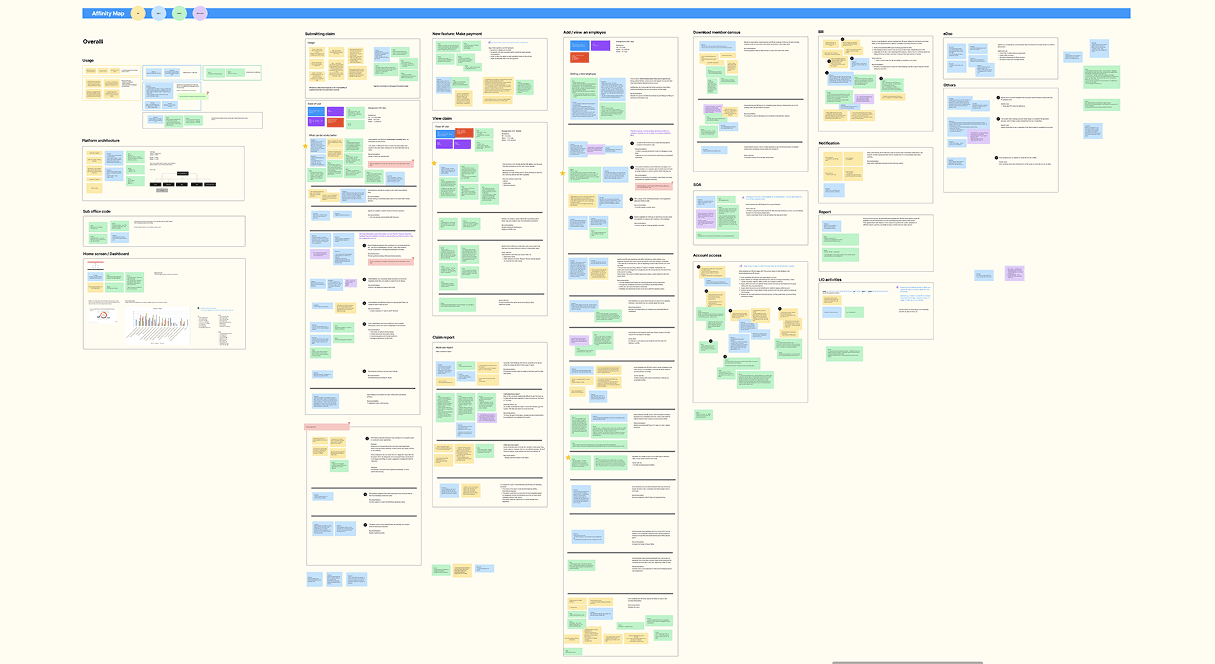
Workshops and interviews showed customers only opened the app during negative moments like filing a claim. Outside of that, the product had no role in their lives, so insurance felt like a cost rather than a service.
The research identified a direction, not a solution. Improving engagement could mean reminders, content, or faster claims, but those would increase activity without changing perception.
I reframed the problem as a behavioral one: the product needed to show value before a claim happens. The goal shifted from optimizing transactions to creating an ongoing relationship.
Constraints
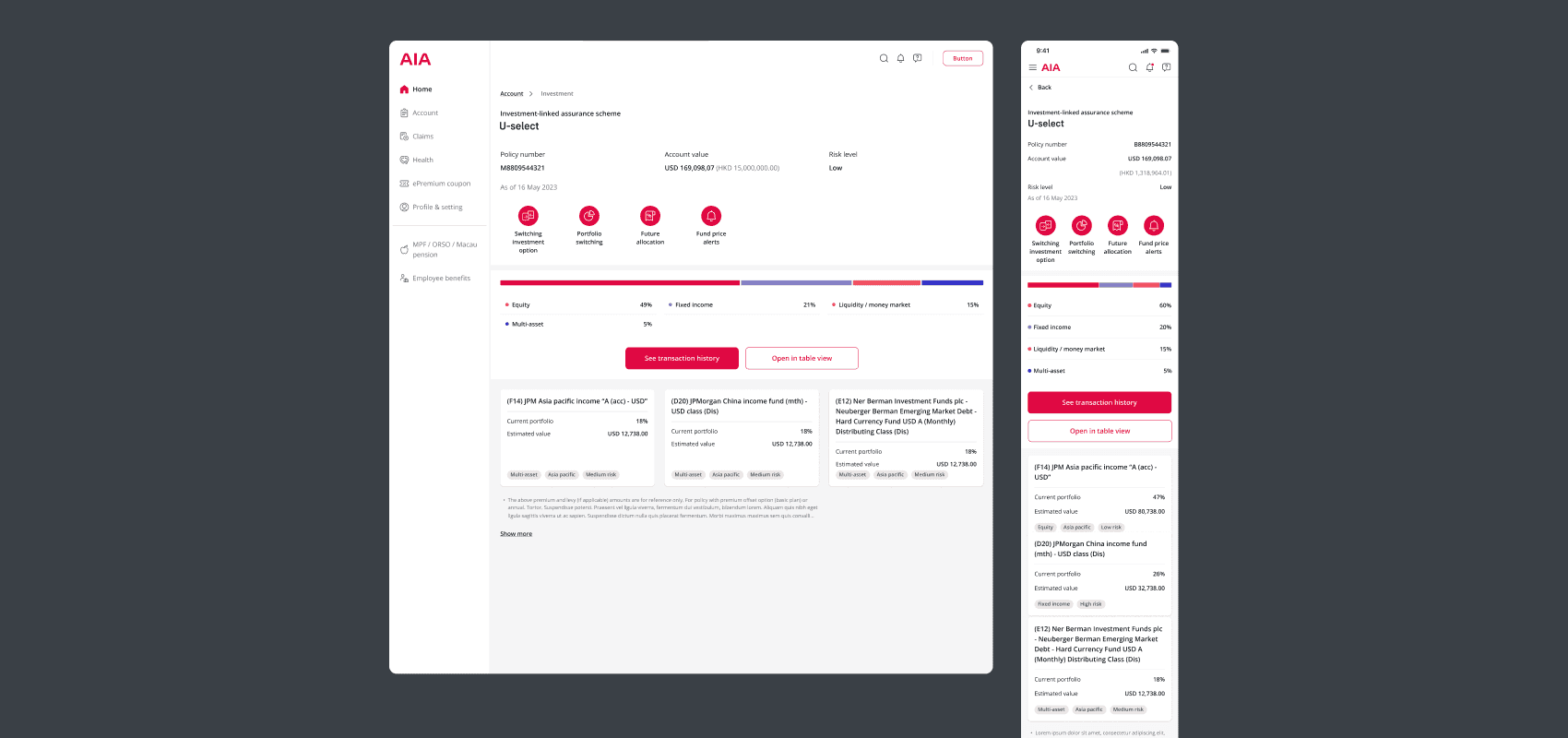
The redesign required balancing two opposing models.
Insurance systems are structured around risk, documentation, and compliance, while engagement products rely on repeat interaction and habit formation.
The product needed to evolve from a servicing utility into an ecosystem that supports daily behavior, without compromising regulatory clarity or operational accuracy across multiple markets.
Approach
With the goal defined, the next step was deciding how the product could regularly demonstrate value.
We evaluated multiple engagement directions such as reminders, content, and rewards. These relied on artificial triggers and risked becoming noise. They could bring users back, but wouldn't make the insurance itself feel useful.
We explored multiple ways to increase engagement such as reminders, educational content, and service shortcuts. These improved activity but did not make insurance itself feel valuable.
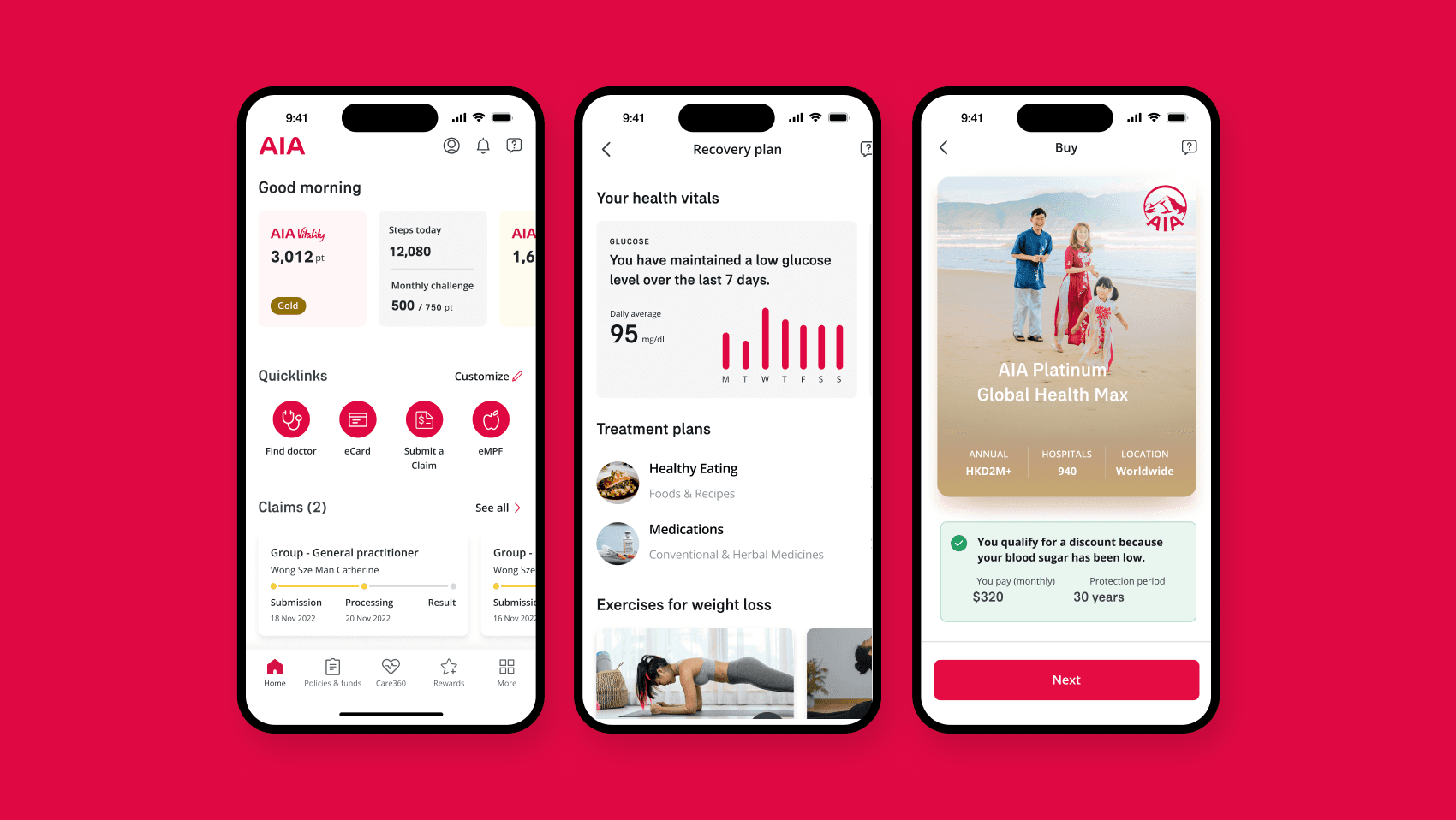
We needed a daily signal directly tied to protection. Health behavior was the closest representation of risk and wellbeing, making it a natural proxy for the value of insurance.
Health became the anchor because it continuously reflects wellbeing and connects to the purpose of insurance. Instead of asking users to think about coverage abstractly, the app could show how their current state relates to their protection.
Guiding principle
“The product should prove its value even when nothing goes wrong.”
Solution
Supporting features reinforced the loop through tangible outcomes. Healthy behavior was not only visualized but connected to real benefits, such as eligibility for discounts or improved coverage terms. This converted health tracking from passive information into actionable value.
The experience therefore progressed beyond reassurance. Healthy behavior was tied to tangible benefits such as rewards and eligibility advantages, turning tracking from information into proof of value. The product no longer waited for illness to prove its worth but continuously rewarded prevention.
- Signal – Capture daily health indicators
- Meaning – Translate them into understandable insights
- Reward – Reflect behavior in benefits or pricing
- Reinforcement – Encourage continued engagement
Validation
Testing focused on whether users would interact with the product without needing a claim or policy change.
Users who engaged with daily features returned more frequently and became more comfortable navigating protection services later. This confirmed that familiarity precedes trust, and trust increases willingness to use core insurance functionality. Familiarity with daily features reduced hesitation when accessing insurance actions.
This showed engagement was not created by insurance features; insurance relevance was created by engagement first.
Because components were reused across flows, successful interactions validated both individual journeys and broader system patterns.
Impact
The redesign improved both usability and product behavior. The product evolved from an emergency utility into a recurring service touchpoint.
- Improvements were not limited to usability. Users began returning without needing a claim.
- SUS above 80 after release
- Increased repeat usage driven by daily features
- Greater exploration of protection services without prompting
- Recognized as a preferred digital insurance experience
Key learning
“Optimizing low-frequency tasks alone does not create product success. In this insurance product, users need continuous everyday value before they ever need transactions. By designing for repeat behavior and building the product alongside reusable components, validated features naturally became scalable patterns. This strengthened engagement, supported long-term business value, and established a foundation for future digital products.”